Achillea Millefolium – Folklore, Signature and (Some of the many) Uses
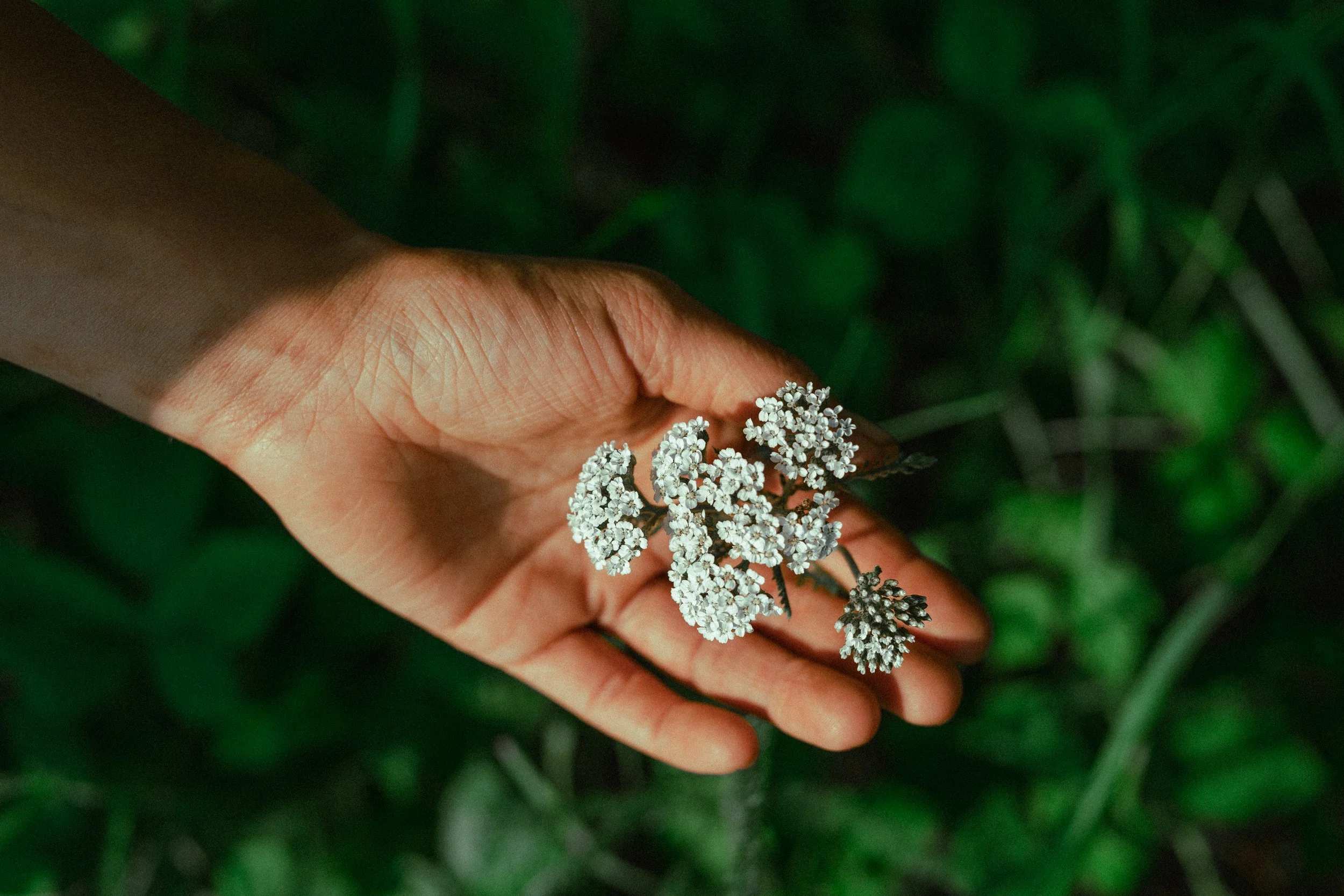
Blooming yarrow
Achillea Millefolium is also known as yarrow. Achillea relates to Achilles, who is said to have treated his wounds with yarrow. Millefolium, on the other hand, translates as “a thousand leaves” and refers to the pinnate leaves, where many small leaves create one large one.
In German, the name of the plant is Schafgarbe, which could be translated as “sheep’s gift,” referring to the fact that sheep like to graze on this plant. But also a gift in the sense that it heals the sheep from infections and offers great medicinal gifts to us as well.
It is really worth spending some time with this plant because it is truly beautiful. For me, the leaves have a sense of elegance, and the flowers just seem to be perfection in themselves. The flowers also have a very specific smell - not really a smell I can connect to any other plant, and especially the essential oil is very particular. I do not like it by itself, but in a mixture with other oils such as rosemary and blood orange, it’s really lovely.
Yarrow is edible, so you can nibble on a leaf or add it to your salad. It tastes a bit bitter, which also gives an indication that it contains bitter substances, which have medicinal value as well. The flowers are white or pink and have tiny ray florets surrounding the disk florets. The flower head looks like an umbel, but it is not actually an umbel because the small flowers do not all emerge from one single spot. The smell is very distinctive and reminds me of chamomile.
A yarrow flower head consists of about 15 to 30 disk florets, which are arranged in a dome- or shield-shaped structure. So, some people mistakenly think that yarrow is part of the Apiaceae, because this family is known to have umbel-shaped flowers where each little flower emerges from the same spot. Yarrow is actually part of the Asteraceae, or Compositae.
If we look at the signature of yarrow, it is said that yarrow’s needle-like leaves are a signature of the predominance of air and fire, giving rise to its high essential oil content. As mentioned earlier, the plant has a high amount of essential oils. It is a creeping plant, which is a signature for blood vessels. Also, the leaves, which are reduced to mere veins, are a signature that this plant can support the blood. Yarrow is said to be one of the best herbs to stop bleeding from fine blood vessels, or to tone the circulation through them.
So, just by looking at the plant, we already get some ideas of what the plant is good for, and it is indeed often used to stop external bleeding. I myself have had this experience with yarrow. Just recently, I got my finger into the blender, and it created this kind of cut that would not stop bleeding. Very messy, if you ask me. So I remembered that I had some dried yarrow and just placed it directly on the cut. Within a few seconds, my finger stopped bleeding, and I also felt an immediate relief of pain.
Because this is what yarrow does: it does not only stop the bleeding because it is mildly astringent, it helps to bring the tissue together and keep infections out of wounds, as it is also antimicrobial. I highly recommend drying some of the leaves and then crushing them into a powder to have on hand for such small accidents.
I guess one could write a whole book about yarrow, but yet another important use I want to mention from my own experience is its use for menstrual pain. This also leads me to my own relationship with this plant and why I have chosen its name for my little project.
Yarrow is traditionally used to support uterine health by relieving menstrual cramps caused by blood stagnation and easing pain related to cold and constriction by increasing blood flow. It also supports digestion when there is bloating and stagnation due to its aromatic properties. Many women may experience digestive issues during their period, which makes it very valuable to include some yarrow.
Yarrow may also help regulate heavy menstrual bleeding and is often combined with cooling and astringent herbs. So, all in all, I love including yarrow in mixes to support the period. I often combine it with rose or tulsi to bring a bit of sweetness and calm into the mix, depending on what I need at that specific moment. .
If you are interested in yarrow, let me know your questions. I am happy to share more of my own experiences.
